
You can reach the ocean floor. You still have to do laundry.
Cassette futurism applied to an ordinary chore: a laundromat inside a deep-sea habitat. Two prompts show the difference between naming an aesthetic and specifying its visible hardware.
For a complete narrative sequence using this visual language, explore The Pelagic Lost-Property Office: intake, examination, and archive, with all three prompts and a continuity review.
The visual language
The cassette futurism community’s own definition describes imagined technology shaped by late-1970s and early-1980s computing: CRTs, removable media, and physical controls. It is a useful visual direction for science-fiction props and environments. The laundry-room subject here is an original application, not a historical example.
- Housings: chunky beveled equipment with recessed displays.
- Interaction: mechanical buttons and switches with a visible physical presence.
- Media and maintenance: removable cartridges and service panels suggest equipment people can handle and repair.
One subject, two descriptions
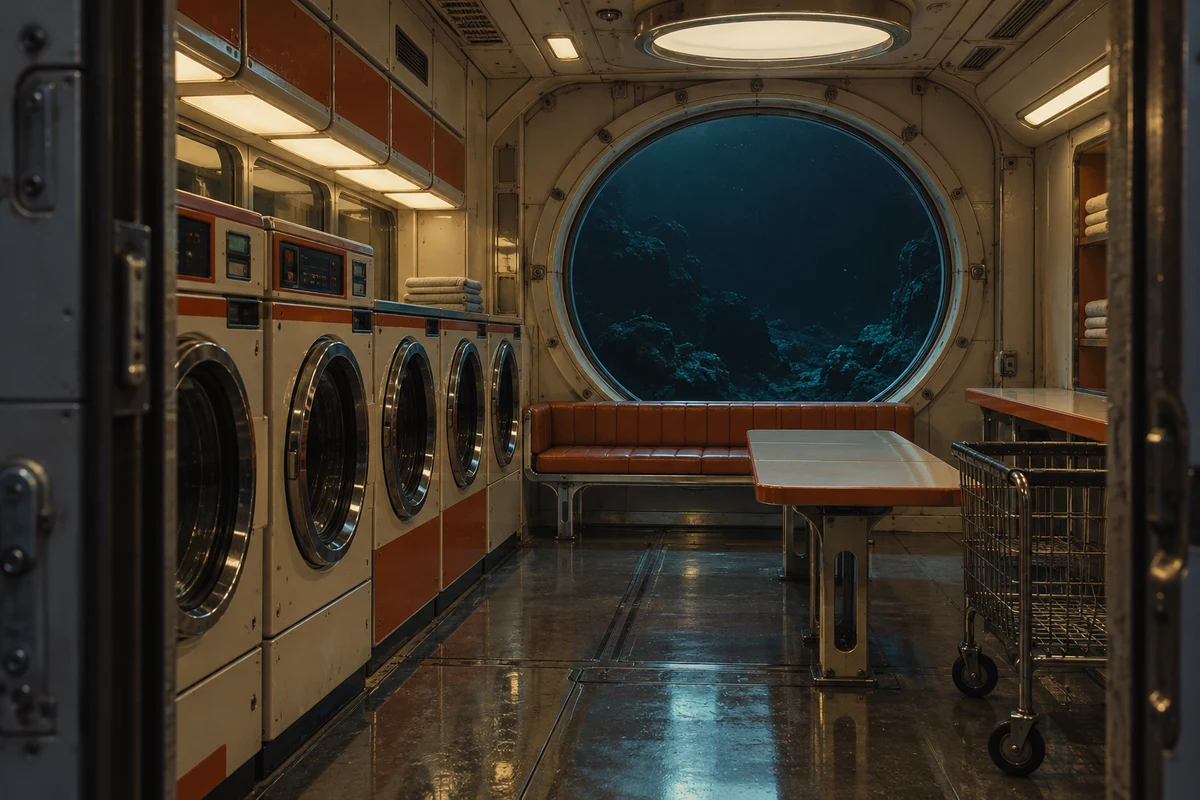
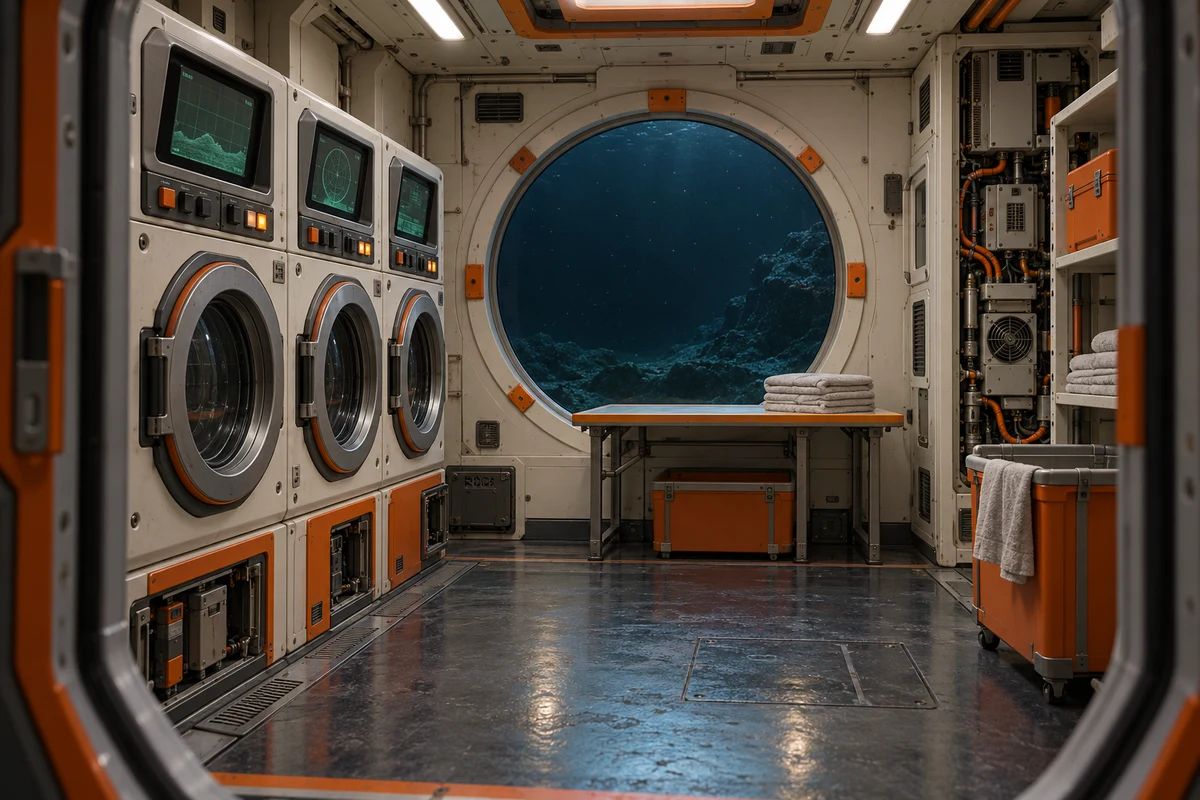
Both prompts use the same deserted laundromat, doorway viewpoint, round window, and ocean setting. A adds only the aesthetic’s name. B adds concrete hardware traits and a restrained palette. Each was generated once, independently, without reference images.
Copy the complete A prompt
A deserted laundromat inside a deep-sea research habitat, viewed from the doorway, with a round observation window looking into dark ocean water. Cassette futurism. No people, lettering, logos, or watermark.
Copy the complete B prompt
A deserted laundromat inside a deep-sea research habitat, viewed from the doorway, with a round observation window looking into dark ocean water. Cassette-futurist industrial design with chunky beveled housings, recessed monochrome CRT displays, tactile mechanical switches, removable data cartridges, and exposed service panels; restrained off-white, charcoal, and safety-orange surfaces. No people, lettering, logos, or watermark.
What worked, and what did not
B visibly includes several of the requested hardware traits. Removable data cartridges are not unambiguously visible, and tiny glyph-like marks remain on the screens despite the request for no lettering. The image is a visual concept; the displays, washing machines, and underwater structure are not verified working designs.
A already has a recognizable retro treatment. The comparison is not evidence that naming an aesthetic fails, or that longer prompts always work better. Several details changed together, there was one output per prompt, and no random seed was exposed. The two images illustrate this attempt; they do not establish causality or repeatability.
A reusable style seed
For a different subject, copy the fixed seed from the cassette futurism entry. The subject stays separate from the style:
Cassette-futurist industrial design with chunky beveled housings, recessed monochrome CRT displays, tactile mechanical switches, removable data cartridges, and exposed service panels; restrained off-white, charcoal, and safety-orange surfaces.
When reviewing an output, look for the physical traits you requested. Count a trait only if you can point to it in the image. A genre label or a green glow by itself does not demonstrate every detail of the style.
About the examples
Generated October 15, 2026 (America/Edmonton; October 16 UTC), with the built-in image generation tool. Its exact model identifier and random seed were not exposed. No reference images were submitted. Original landscape images were exported as 1200 × 800 WebPs without retouching. Both received AI visual inspection; no human review or cross-model test is claimed.
Related: retro science-fiction film treatment focuses on film grain, lighting, and set construction. Cassette futurism here focuses on equipment, controls, and media. For another limited prompt experiment, see the botanical cyanotype comparison.