
AN ORIGINAL FICTIONAL CASE FILE
The ocean returns things. None of them have owners.
The Pelagic Lost-Property Office files objects recovered from the deep. Today’s return looks like an audio cassette. It grew as a shell.
One impossible object, treated with the patience of an ordinary municipal office. This three-frame study uses cassette futurism for the equipment, and one recurring specimen to carry the story.
1. Intake
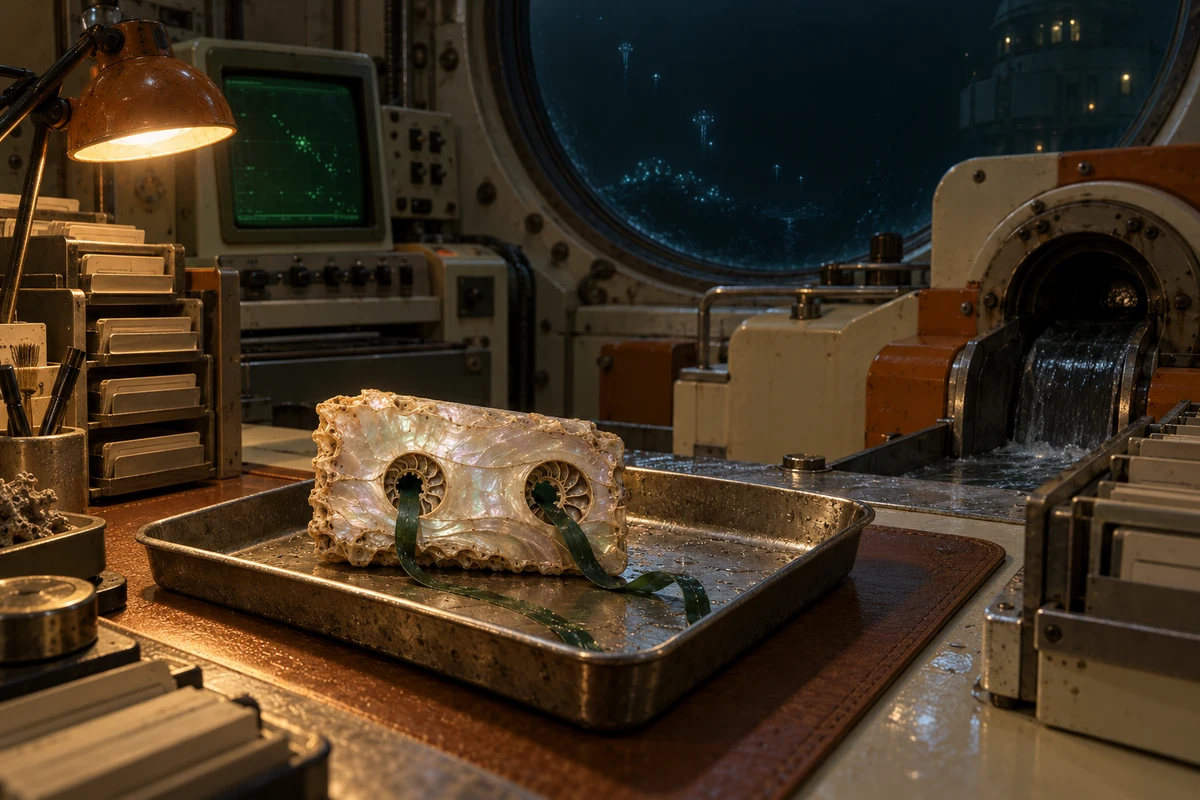
Generated without reference images.
Read the complete submitted prompt
Create one original cinematic landscape image, an establishing frame from a quiet fictional world called The Pelagic Lost-Property Office. A municipal lost-and-found counter inside a deep-sea habitat, no people. Ordinary patient bureaucracy confronting an impossible ocean. Foreground: a worn brushed-steel intake tray holding ONE strange recovered object, about the size of a hand: an ivory nacre shell grown into the rectangular proportions of an audio cassette, its two reel holes naturally formed spiral chambers, a single continuous dark teal ribbon of kelp threaded through them. It is visibly grown, with shell growth ridges and asymmetric edges, never a plastic cassette with shells glued on. Behind: a circular seawater return hatch, damp return chute, chunky cream-and-oxidized-orange equipment, recessed green monochrome CRT, mechanical switches, removable cartridge racks, brown rubber desk mat. One small warm amber task lamp picks out the nacre specimen. Through a thick round window is black water with a few distant bioluminescent pinpoints. Compose as a credible practical miniature-film set with tactile materials, reserved shadows, restrained colors, subtle grain. The mystery comes from the inexplicable object treated as routine paperwork, not from monsters. No people, gore, weapons, legible writing, labels, titles, logos, watermarks, holograms, collage or multiple panels. One image.
2. Examination
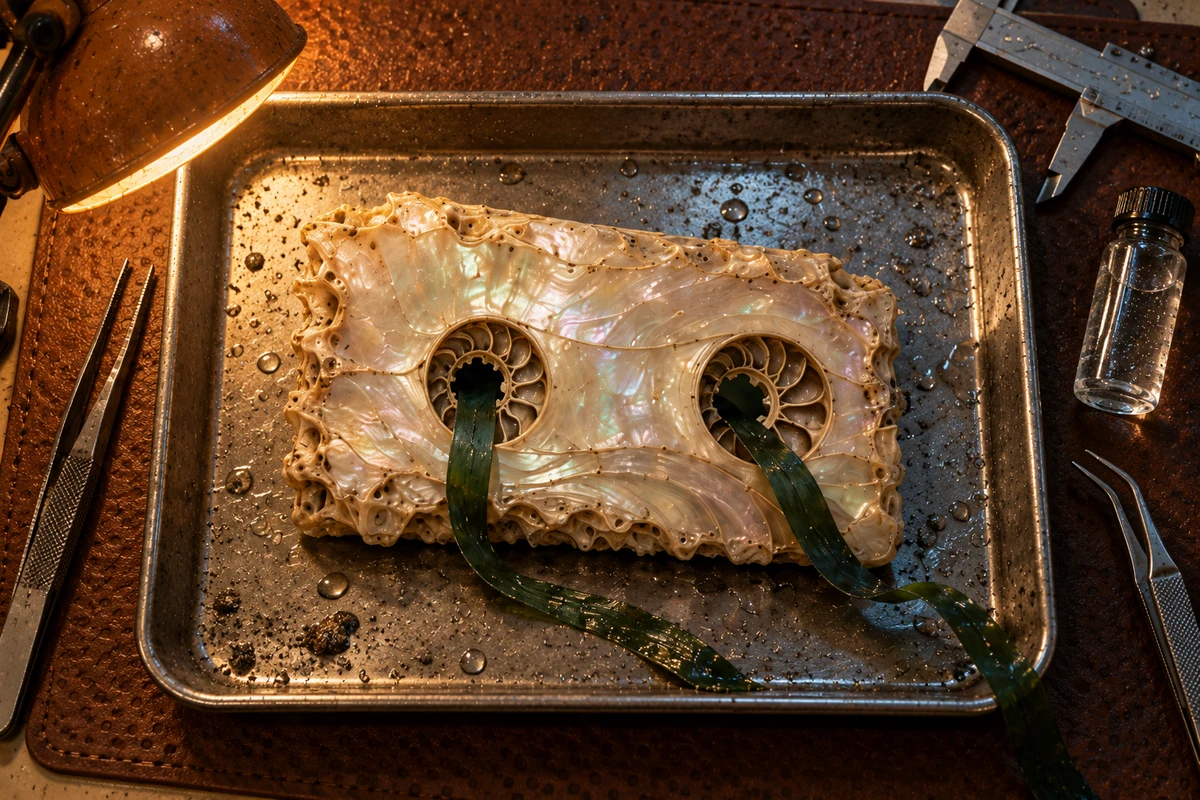
Reference inputs: Intake. These generated frames guided appearance; this is a new viewpoint, not a crop.
Read the complete submitted prompt
Create ONE new landscape frame from The Pelagic Lost-Property Office, using the attached image only as a reference for the recovered object and materials. This is a new evidence-photography viewpoint in the same fictional office, not a crop of the reference. Top-down close inspection photograph: the same hand-sized irregular rectangular ivory nacre shell-cassette, TWO naturally grown spiral reel chambers, rough asymmetric shell-growth rim and a dark teal kelp ribbon threading both chambers, resting flat in a shallow worn brushed-steel tray on a brown rubber examination mat. Keep the object recognizable as the same specimen: pearl ivory, two circular spiral chambers, no plastic casing, no screws in the specimen. Three unmarked loose caliper tools and a small clear vial with seawater sit at the frame edges; do not obscure the object. Hard warm amber task light from upper left, weak cold blue reflected light from lower right, visible wet nacre iridescence and traces of black sand. The shell surface and ribbon should be sharply inspectable, practical miniature-film-set realism, restrained cream/charcoal/oxidized-orange surroundings. No humans or hands, writing, ruler numbers, labels, logos, watermark, panels, decorative frames, or diagram overlays. Treat as a surreal fictional artifact, not a real biological specimen.
3. Archive
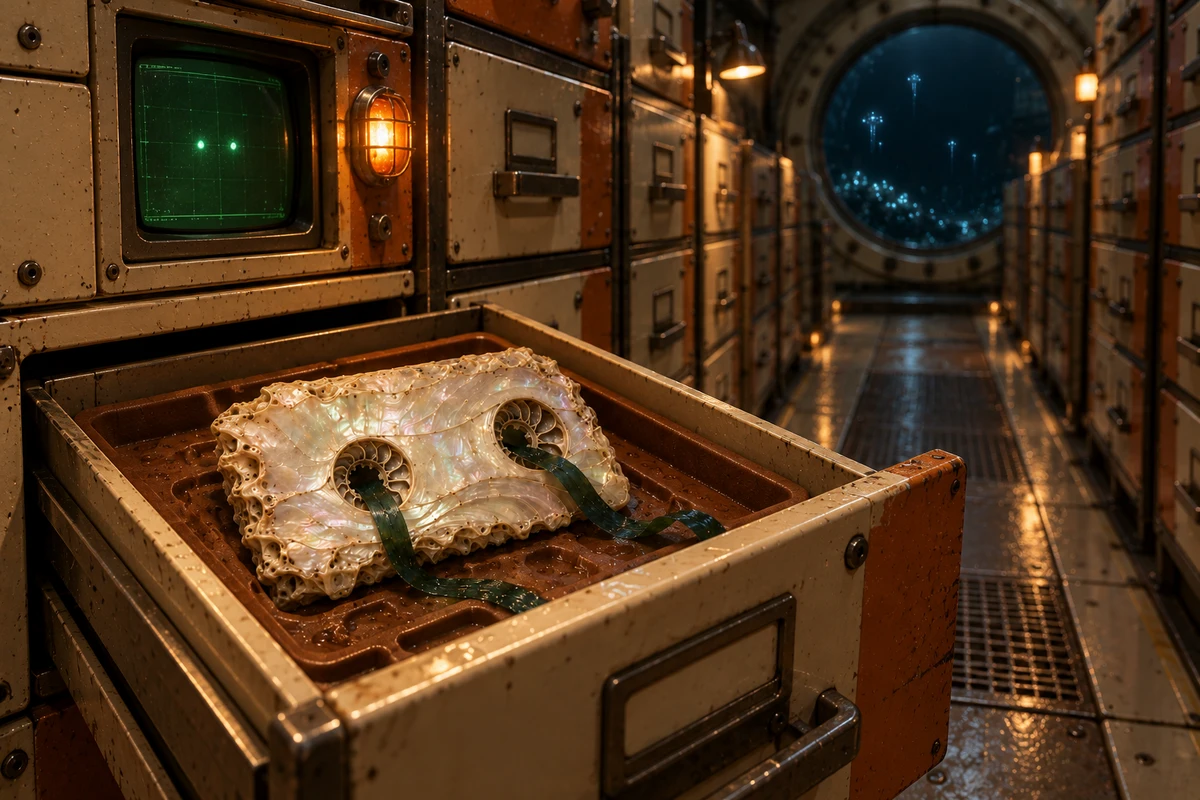
Reference inputs: Intake and Examination. These generated frames guided appearance; this is a new viewpoint, not a crop.
Read the complete submitted prompt
Create ONE new original landscape frame from The Pelagic Lost-Property Office. Use attached image 1 as the office material/lighting reference and attached image 2 as the specimen identity reference. Tell the final beat of a quiet visual story: the returned thing is carefully archived although nobody knows its owner. Low eye-level close view down a long cream-and-oxidized-orange municipal filing cabinet aisle in a deep-sea habitat. ONE foreground shallow drawer is pulled open, holding the SAME hand-sized ivory nacre shell grown into irregular rectangular audio-cassette proportions, TWO naturally formed spiral reel chambers, rough shell-growth rim, dark teal kelp ribbon threaded through the chambers. Keep the specimen entirely visible in a brown rubber fitted tray, with small drops of seawater. All other drawers are CLOSED; no other specimens or creatures. Near the open drawer, a chunky recessed green CRT with an abstract pair of dots and a mechanical amber status bulb. A round pressure-window at the far end reveals black ocean and tiny bioluminescent pinpoints, suggesting that more returns may arrive. Restrained amber task lighting, cream, charcoal and worn orange enamel, practical miniature-set cinematic realism and subtle grain. Match the shell identity and equipment design to the references, change viewpoint and staging. No people, faces, gore, threatening creature, text, numbers, file labels, logos, watermarks, holograms, collage, borders or multiple panels.
How the story holds together
Each frame has a job: arrival establishes a mystery, examination makes the object inspectable, and storage shows how the office responds. The imagery suggests a larger world without needing an explanatory label inside the picture.
Five anchors recur: ivory nacre, two spiral chambers, an irregular rectangular shell rim, dark teal kelp ribbon, and cream-and-orange equipment with green CRTs. The intake image supplies a visual reference for the examination; both supply references for the archive.
The contrast is deliberate: unfamiliar biology, familiar administration. The shell’s cassette-like shape links the recovered object to the office’s physical-media equipment. The steel tray and filing drawer make handling and storage part of the story.
Where continuity breaks
The specimen stays recognizable, but its exact outline and ribbon placement change. The examination view is angled rather than strictly top-down. Requested tool counts were not followed literally, and tiny tool or screen markings slipped through the no-writing instruction. This is coherent art direction, not exact object reconstruction.
The pictures cannot independently establish the object’s size, origin, or how the underwater habitat functions. Those are fictional premises. No biological discovery, pressure engineering, or working device is claimed.
Try the structure with your own story
- Choose one contradiction that can be seen: something grown into a manufactured shape, for example.
- Give each image a different story function. Keep one place, one object, and one handling procedure.
- Write a short list of visual anchors. Reuse that wording, then attach earlier frames as appearance references where your tool supports them.
- Change viewpoint and action rather than merely asking for another image in the same style.
- Review the sequence for both story progression and object drift. Keep a record of what failed.
This is the workflow used for these three outputs, not a benchmark against other methods. The full prompts and exact reference relationships are included above so you can inspect the attempt.
Image provenance
Created October 16, 2026, using the built-in image generation tool. Exact model identifier and random seed were not exposed. The only reference images were earlier original generated frames from this series. Three generation calls produced three selected frames. Originals were exported to 1200 × 800 WebP without retouching. Visual inspection was performed by an AI assistant; no human review is claimed.
For a simpler exercise in specifying equipment, see the deep-sea laundromat prompt comparison.